Stay Connected to
the Current!
The Ville's next chapter is being written right now. Get neighborhood news, upcoming events, and stories of restoration, straight to your inbox. No noise, just roots.
In St. Louis and Along the Mississippi River
The Underground Railroad in St. Louis, Missouri, occupied one of the most strategically important locations in the history of American slavery and freedom. Situated on the western bank of the Mississippi River at the border between the slave state of Missouri and the free state of Illinois, St. Louis served as both a major center of the domestic slave trade and a critical gateway for African Americans seeking liberty. The Mississippi River stood at the heart of this contradiction, functioning simultaneously as a commercial highway that sustained slavery and as a pathway through which freedom seekers attempted to escape.
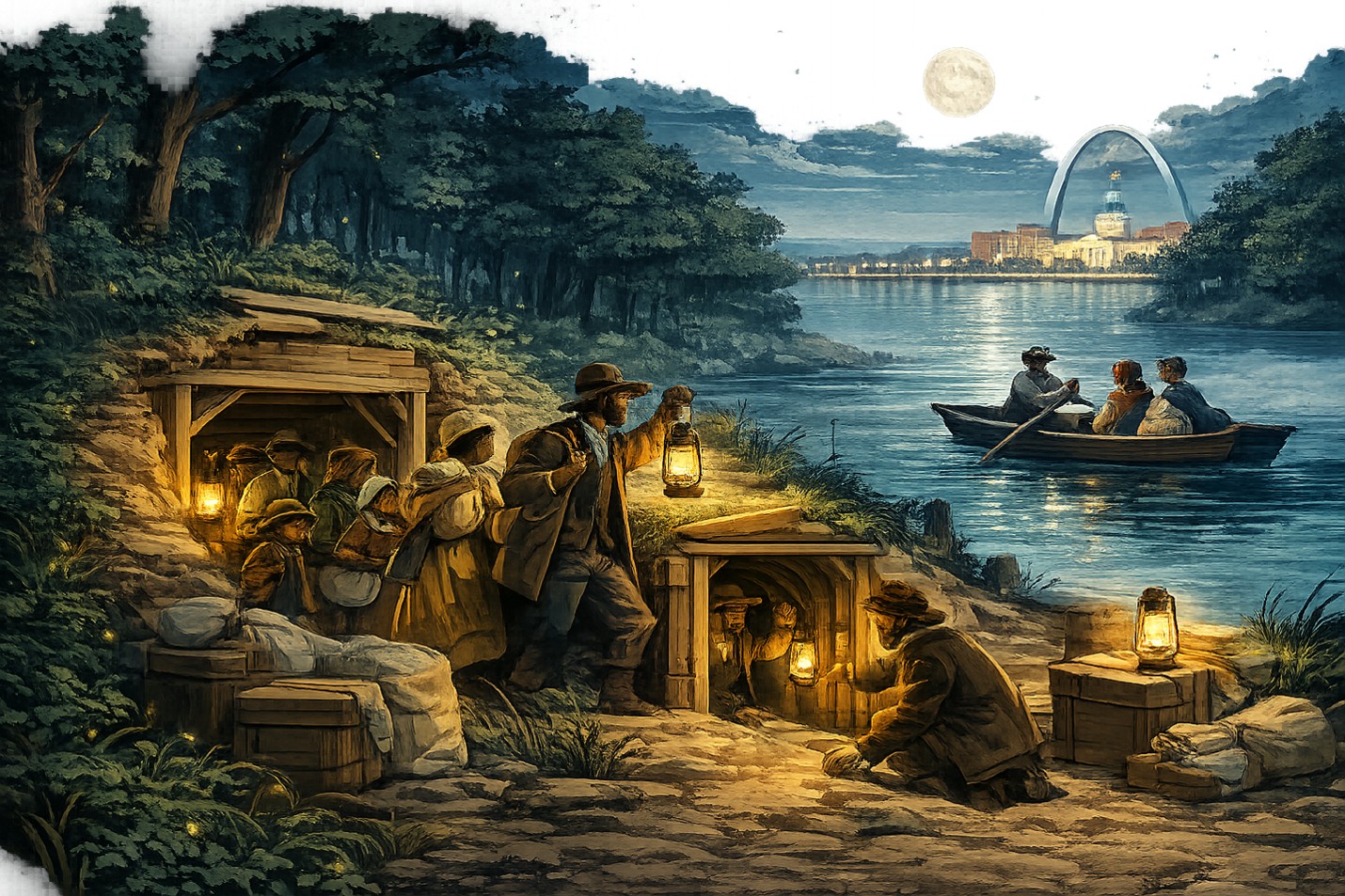
Unlike the highly organized Underground Railroad networks of the Northeast, escape efforts in the Mississippi Valley were often decentralized, relying upon trusted relationships among free Black communities, abolitionists, river workers, church leaders, and sympathetic allies. Enslaved men and women crossed the Mississippi River by skiff, canoe, ferry, and commercial riverboat, hoping to reach Illinois before slave catchers or law enforcement intercepted them. Every crossing carried enormous risk, particularly after the Fugitive Slave Act of 1850 expanded the authority of enslavers and federal officials to pursue and capture freedom seekers, even in free states.
Among the most influential figures in St. Louis’s freedom movement were Reverend John Berry Meachum and his wife, Mary Meachum. Together, they dedicated their lives to advancing Black freedom through education, economic independence, and direct assistance to enslaved people seeking liberty. John Berry Meachum, a formerly enslaved minister, entrepreneur, and educator, founded the First African Baptist Church of St. Louis and established schools for both free and enslaved African Americans. When Missouri prohibited the education of Black people in 1847, the Meachums continued teaching through the celebrated Floating Freedom School, conducted aboard a vessel moored on the Mississippi River. Although historians continue to debate the precise legal protections afforded by its location on navigable waters, the school became one of the nation’s most enduring symbols of educational resistance and Black self-determination.
Mary Meachum emerged as one of Missouri’s most courageous Underground Railroad conductors. Following John Berry Meachum’s death in 1854, she continued assisting enslaved people seeking freedom. On the night of May 21, 1855, she participated in an attempt to help a group of eight or nine enslaved men, women, and children cross the Mississippi River from St. Louis into Illinois. The escape was betrayed before it could succeed. Law enforcement officers and slaveholders intercepted the party on the Illinois shore, recaptured most of the freedom seekers, and arrested Mary Meachum and others accused of aiding the escape. Although charges against Mary Meachum were ultimately dismissed or resulted in acquittal, the event became one of the best-documented Underground Railroad incidents in Missouri history. It remains exceptional because contemporary newspaper accounts and court records provide rare documentary evidence of an Underground Railroad operation in the state.
Today, the site of that attempted crossing is preserved as the Mary Meachum Freedom Crossing on the St. Louis riverfront. Dedicated in 2001 as the first Missouri location included in the National Park Service’s National Underground Railroad Network to Freedom, it honors not only Mary Meachum’s courage but also the determination of the unnamed freedom seekers who risked everything in pursuit of liberty. The annual Mary Meachum Freedom Crossing commemoration continues to preserve their story and recognize the contributions of St. Louis’s free Black community to the national struggle against slavery.
The Mississippi River itself embodied one of the great paradoxes of American history. It carried cotton produced by enslaved labor, transported enslaved people through the domestic slave trade, and generated immense wealth for the slave economy. Yet the same river also offered opportunities for resistance. Black steamboat workers, dockworkers, ferrymen, ministers, business owners, and community leaders shared information, built networks of trust, and, when circumstances allowed, helped freedom seekers move toward safety. While many escape attempts ended in capture, others succeeded, contributing to the broader movement that challenged slavery and exposed its moral contradictions.
The Underground Railroad in St. Louis was therefore more than a collection of secret routes. It was a community-wide movement grounded in faith, education, mutual aid, and extraordinary courage. Through the leadership of John and Mary Meachum and countless unnamed African Americans who risked imprisonment, violence, or death to assist others, St. Louis became one of the Mississippi Valley’s most significant centers of resistance to slavery. Their legacy reminds us that the Mississippi River was not merely a boundary between slave and free territory—it was a contested landscape where the struggle for freedom unfolded one courageous crossing at a time.